
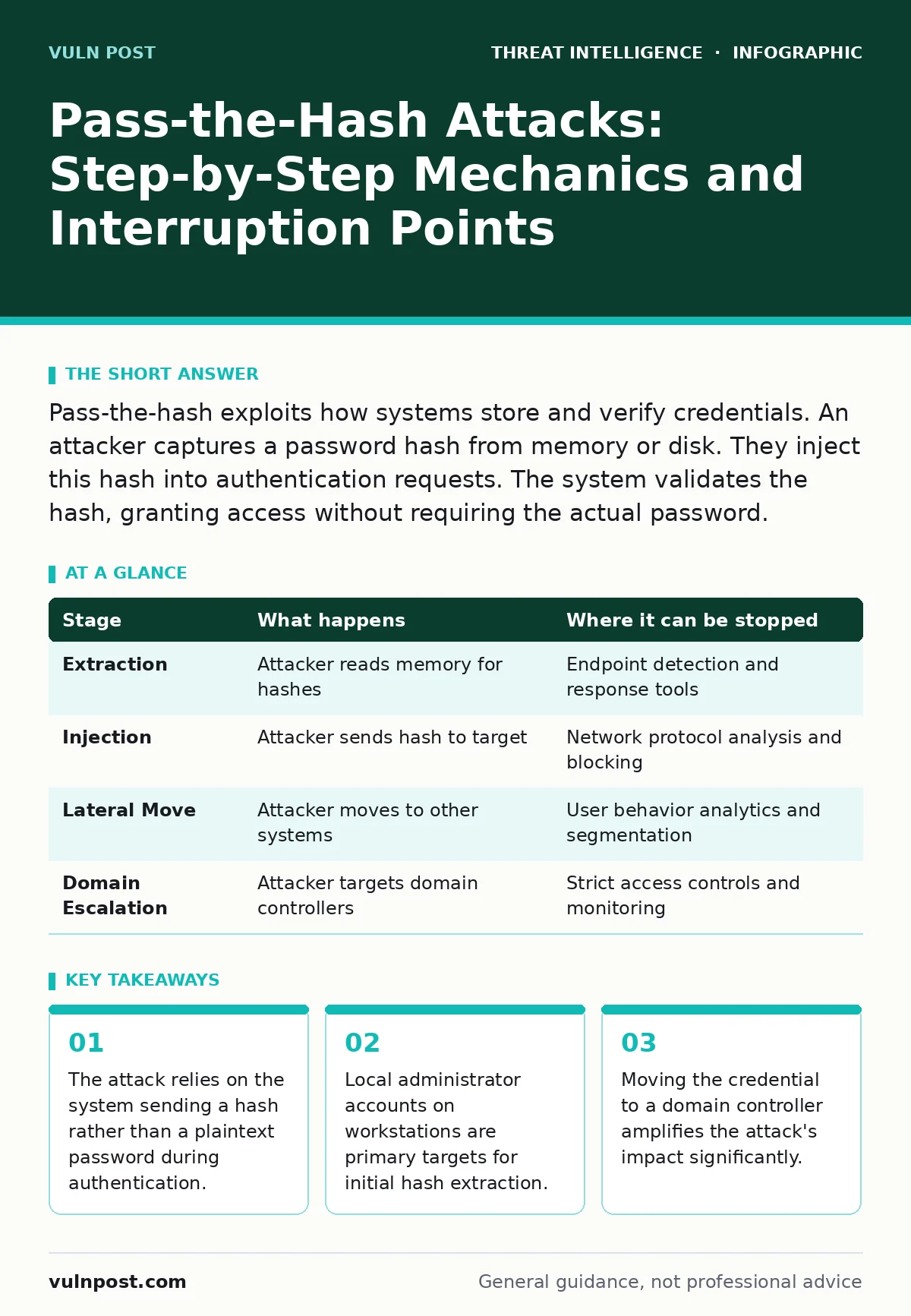
Pass-the-hash exploits how systems store and verify credentials. An attacker captures a password hash from memory or disk. They inject this hash into authentication requests. The system validates the hash, granting access without requiring the actual password.
The Credential Storage Mechanism
Modern operating systems do not store passwords in plain text. Instead, they hash the password using a specific algorithm. This hash is a fixed-length string derived from the original password. When you log in, the system hashes your input and compares it to the stored value. If they match, access is granted.
This design protects against casual inspection of storage files. However, it creates a specific vulnerability. The system trusts the hash as proof of identity. It does not care how the hash was obtained. It only cares that the hash matches the stored record. This trust model is the foundation of the attack.
Stage 1: Initial Access and Privilege Escalation
The attacker begins by gaining a foothold on a single endpoint. This could be a workstation or a server. They often use social engineering or a software flaw to enter the network. Once inside, they need local administrative rights. Without these rights, they cannot access the memory areas where credentials are stored.
Local administrators have access to the Security Accounts Manager database. This database stores the hashes for local accounts. The attacker escalates their privileges to reach this level. They may exploit a misconfigured service or a known vulnerability in the operating system. This step is critical because standard user accounts do not hold the necessary data.
Stage 2: Hash Extraction from Memory
With administrative rights, the attacker targets the running processes. The operating system loads credentials into memory for active sessions. Tools can scan this memory to find strings that look like password hashes. These hashes are often labeled with the username and the security identifier of the account.
The attacker extracts these hashes. They do not need to crack them. Cracking is slow and often fails against complex passwords. Instead, they simply copy the hash value. This value is usually a 32-character hexadecimal string. It represents the LM hash or the NTLM hash of the password.
Stage 3: Credential Injection and Authentication
The attacker now has the hash. They move to a target machine on the network. This target could be another workstation or a server. The attacker uses a tool to initiate a connection to the target. Instead of sending a password, they send the captured hash.
The target system receives the authentication request. It sees the hash and treats it as a valid password submission. The system hashes the provided value again or compares it directly, depending on the protocol. Since the hash matches the stored record, the system grants access. The attacker never knew the actual password.
Stage 4: Lateral Movement and Domain Escalation
This is where the attack scales. The attacker uses the stolen hash to move sideways across the network. They target machines where the same user account has privileges. If the account is a domain administrator, the impact is severe. The attacker can access any machine in the domain.
The attacker may move the hash to a domain controller. This is a high-value target. Compromising a domain controller allows the attacker to reset passwords for all users. They can also create new accounts or modify group policies. This step transforms a local compromise into a total network breach.
See also: Angler Phishing Mistakes: 7 Errors That Expose Your Team
Interruption Points and Detection
You can interrupt this process at several stages. The first is during extraction. Monitoring for unusual memory access by non-system processes can reveal this activity. The second is during injection. Network traffic analysis can detect anomalies in authentication protocols. The third is during lateral movement. Baseline normal login patterns to spot unusual access from unexpected sources.
The Role of Protocol Selection
The success of this attack depends on the authentication protocol. Older protocols like NTLM allow the hash to be passed directly. Newer protocols like Kerberos require a ticket, not a hash. However, the hash can be used to obtain a Kerberos ticket. This makes the attack viable even in modern environments.
Understanding this distinction is key. You cannot stop the attack by simply updating software. You must change how credentials are handled. This leads to the need for more advanced security models.
Mitigation Strategies and Trade-offs
Pass-the-hash is difficult to stop completely. You must reduce the number of accounts with local admin rights. This limits the initial extraction point. You should also enforce the use of virtual accounts for services. These accounts have unique passwords that are hard to guess or extract.
Another strategy is to use protocol restrictions. You can configure systems to reject NTLM authentication. This forces the use of Kerberos. While this reduces the attack surface, it may break legacy applications. You must test these changes carefully.
| Stage | What happens | Where it can be stopped |
|---|---|---|
| Extraction | Attacker reads memory for hashes | Endpoint detection and response tools |
| Injection | Attacker sends hash to target | Network protocol analysis and blocking |
| Lateral Move | Attacker moves to other systems | User behavior analytics and segmentation |
| Domain Escalation | Attacker targets domain controllers | Strict access controls and monitoring |
Broader Context in Threat Intelligence
This attack is part of a larger pattern of Active Directory attacks. It often follows initial access via phishing or malware. The goal is always privilege escalation. Understanding this flow helps in building detection use cases. You can look for sequences of events that match this pattern.
Operational threat intelligence helps you prioritize these risks. You can focus on protecting high-value accounts. This reduces the noise in your alerts. It also helps manage alert fatigue by focusing on likely threats.
Limitations and Future Trends
Pass-the-hash has limitations. It requires the attacker to have local admin rights on at least one machine. It also relies on the reuse of passwords across systems. If every account has a unique, complex password, the impact is limited.
Future trends include the decline of password-based authentication. Certificate-based authentication and passkeys do not use hashes in the same way. These methods are harder to intercept. However, they require significant infrastructure changes.
Conclusion of Analysis
The pass-the-hash attack exploits a fundamental design choice. Trusting a hash as proof of identity is efficient but risky. You must balance this efficiency with security. By understanding the steps, you can build better defenses. Focus on limiting privileges and monitoring for unusual authentication patterns.
Key takeaways
- The attack relies on the system sending a hash rather than a plaintext password during authentication.
- Local administrator accounts on workstations are primary targets for initial hash extraction.
- Moving the credential to a domain controller amplifies the attack's impact significantly.
Frequently asked questions
Can pass-the-hash work over the internet?
No, it typically requires direct network access to the target system. It relies on local network protocols like SMB or RPC.
Does changing the password stop the attack?
Yes, if you change the password, the old hash becomes invalid. The attacker must extract the new hash to continue.
Is pass-the-hash the same as pass-the-ticket?
No. Pass-the-hash uses the password hash. Pass-the-ticket uses a Kerberos ticket. Both allow lateral movement but use different mechanisms.
How do I detect pass-the-hash in logs?
Look for authentication events where the source IP does not match the expected user location. Also monitor for multiple failed logins followed by success.
How this guide was produced: written by the Vuln Post editorial team with AI assistance, checked against the public references listed below, and reviewed when the facts change. See our editorial policy or report an error.