
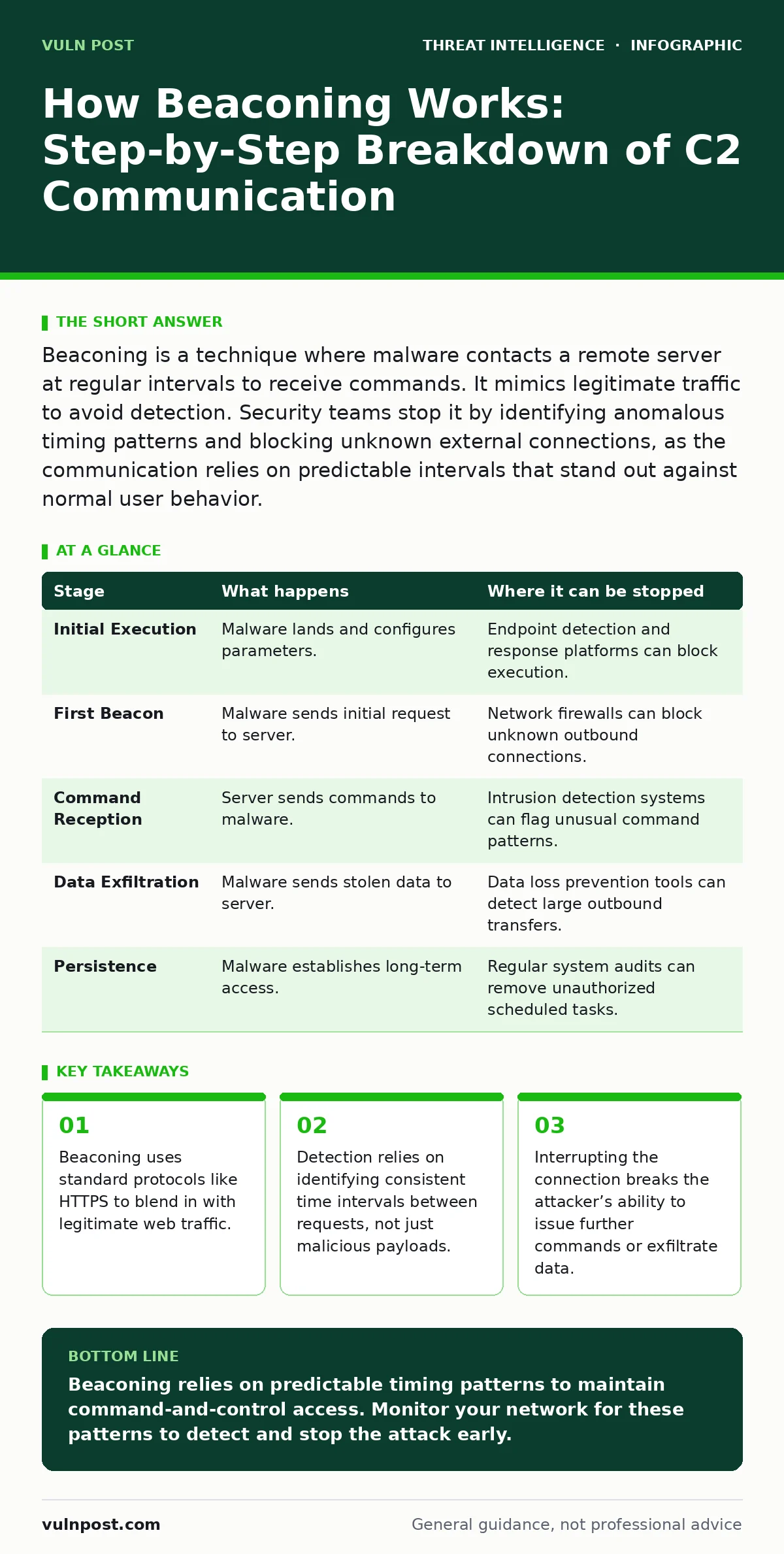
Beaconing is a technique where malware contacts a remote server at regular intervals to receive commands. It mimics legitimate traffic to avoid detection. Security teams stop it by identifying anomalous timing patterns and blocking unknown external connections, as the communication relies on predictable intervals that stand out against normal user behavior.
The Mechanics of Persistent Communication
Malware often needs to maintain a persistent connection to its controller without being noticed. This is where beaconing comes in. Instead of a continuous stream of data, the malware sends small, periodic signals to a command-and-control server. This method is efficient and stealthy. It consumes minimal bandwidth and avoids triggering alarms based on data volume.
The core mechanism is simple. The infected host waits for a specific duration, then sends a request. The server responds with instructions or new code. If the server does not respond, the malware waits again. This cycle repeats until the malware is removed or the server is taken offline. The attacker relies on the fact that most network security tools focus on what is being sent, not when it is being sent.
Stage 1: Initial Execution and Setup
The process begins when the malware lands on the target system. This usually happens through a phishing email, a drive-by download, or an exploit kit. Once executed, the malware establishes its presence. It may drop additional files or modify system settings to ensure it runs on startup.
At this stage, the malware configures its beaconing parameters. It sets the interval, the destination URL, and the method of communication. These parameters might be hardcoded or downloaded from a configuration file. The attacker chooses these settings to mimic legitimate traffic. For example, the malware might use HTTPS to encrypt its communications. This makes it difficult for network defenders to inspect the content of the packets.
Stage 2: The First Beacon
After configuration, the malware sends its first beacon. This is often a simple HTTP GET or POST request. The request contains minimal data, such as a unique identifier for the infected host. The server logs this identifier and associates it with the specific malware instance.
This initial contact is critical. It confirms that the malware is active and that the command-and-control channel is open. If the server does not respond, the malware may retry after a longer interval. This is known as jitter. Jitter adds randomness to the timing to make pattern detection harder. However, even with jitter, the overall pattern remains somewhat predictable over time.
Stage 3: Command Reception and Execution
Once the server acknowledges the beacon, it can send commands back to the malware. These commands might instruct the malware to download additional tools, scan the local network, or steal data. The malware executes these commands and sends the results back to the server.
This stage is where the real damage occurs. The attacker can use the beacon to pivot to other systems on the network. For instance, the malware might use pass-the-hash attacks to move laterally. It can also deploy ransomware or install keyloggers. The beaconing channel remains open for the duration of the attack. The attacker can change the frequency of the beacons to avoid detection or to increase the speed of data exfiltration.
Stage 4: Data Exfiltration
If the attacker wants to steal data, they use the beaconing channel to send it out. Large files are broken into small chunks. Each chunk is sent in a separate beacon response. This keeps the data volume low and avoids triggering alerts based on bandwidth usage.
The malware might encode the data to make it look like random noise. It might also use domain generation algorithms to create new command-and-control domains. This makes it hard for defenders to block the traffic by IP address or domain name. The attacker relies on the fact that most organizations do not monitor outbound traffic for small, periodic data transfers.
See also: Threat Actor Naming Conventions: What Small Teams Need to Know · Domain Fronting Mistakes: 6 Ways Your Network Gets Bypassed
Stage 5: Persistence and Evasion
To ensure the beaconing continues, the malware establishes persistence. It creates scheduled tasks, registry entries, or service installations. It may also hide its processes to avoid detection by endpoint security tools. This is a form of defense evasion. The goal is to remain undetected for as long as possible.
The attacker might also use bulletproof hosting for the command-and-control servers. These hosts are less likely to be shut down due to abuse reports. This adds another layer of resilience to the attack. Even if defenders identify the beaconing, they may not be able to take down the server quickly.
Interrupting the Beaconing Cycle
Beaconing can be interrupted at several stages. The most effective method is network monitoring. By analyzing the timing of outbound connections, you can identify patterns that deviate from normal behavior. Look for connections that occur at regular intervals, even if the content is encrypted.
You can also use threat intelligence feeds to block known command-and-control domains. However, attackers frequently change these domains. Therefore, you need to combine signature-based detection with behavioral analysis. This approach helps you catch new and unknown beaconing activity.
| Stage | What happens | Where it can be stopped |
|---|---|---|
| Initial Execution | Malware lands and configures parameters. | Endpoint detection and response platforms can block execution. |
| First Beacon | Malware sends initial request to server. | Network firewalls can block unknown outbound connections. |
| Command Reception | Server sends commands to malware. | Intrusion detection systems can flag unusual command patterns. |
| Data Exfiltration | Malware sends stolen data to server. | Data loss prevention tools can detect large outbound transfers. |
| Persistence | Malware establishes long-term access. | Regular system audits can remove unauthorized scheduled tasks. |
The Hidden Costs of Detection
Detecting beaconing is not just about technical tools. It is also about managing alert fatigue. If your system generates too many false positives, analysts will ignore them. This is why tuning your detection rules is critical. You need to balance sensitivity with accuracy.
Another hidden cost is the time required to investigate alerts. Each potential beaconing event needs to be verified. This can take hours or even days. Therefore, you need to prioritize alerts based on risk. Focus on high-value assets and critical systems first.
Advanced Detection Techniques
To improve your detection capabilities, you can use detection use cases that focus on behavioral anomalies. For example, you can look for processes that make network connections at unusual times. You can also monitor for connections to newly registered domains. These domains are often used for command-and-control servers.
You can also analyze DNS queries. Beaconing malware often uses DNS tunneling to exfiltrate data. This involves encoding data in DNS queries and responses. By monitoring DNS traffic for unusual patterns, you can detect this type of beaconing.
Conclusion of the Cycle
The beaconing cycle continues until the malware is removed or the server is taken offline. At this point, the attacker loses access to the infected system. This is why rapid detection and response are critical. The longer the beaconing continues, the more damage the attacker can do.
Understanding the stages of beaconing helps you build better defenses. By focusing on timing patterns and behavioral anomalies, you can detect even the most stealthy malware. Remember that no single tool is enough. You need a layered approach that combines network monitoring, endpoint protection, and threat intelligence.
Key takeaways
- Beaconing uses standard protocols like HTTPS to blend in with legitimate web traffic.
- Detection relies on identifying consistent time intervals between requests, not just malicious payloads.
- Interrupting the connection breaks the attacker’s ability to issue further commands or exfiltrate data.
Beaconing relies on predictable timing patterns to maintain command-and-control access. Monitor your network for these patterns to detect and stop the attack early.
Frequently asked questions
What is the difference between beaconing and C2?
Beaconing is the specific technique of periodic communication, while C2 refers to the broader infrastructure and commands used by the attacker.
Can beaconing be detected by a firewall?
Traditional firewalls struggle to detect beaconing because it uses standard protocols. You need next-generation firewalls or intrusion detection systems that analyze behavior.
How do attackers hide beaconing traffic?
Attackers use encryption, jitter, and domain generation algorithms to make beaconing traffic look like legitimate web browsing.
What is jitter in beaconing?
Jitter is the random variation added to the beaconing interval to make pattern detection more difficult.
How this guide was produced: written by the Vuln Post editorial team with AI assistance, checked against the public references listed below, and reviewed when the facts change. See our editorial policy or report an error.