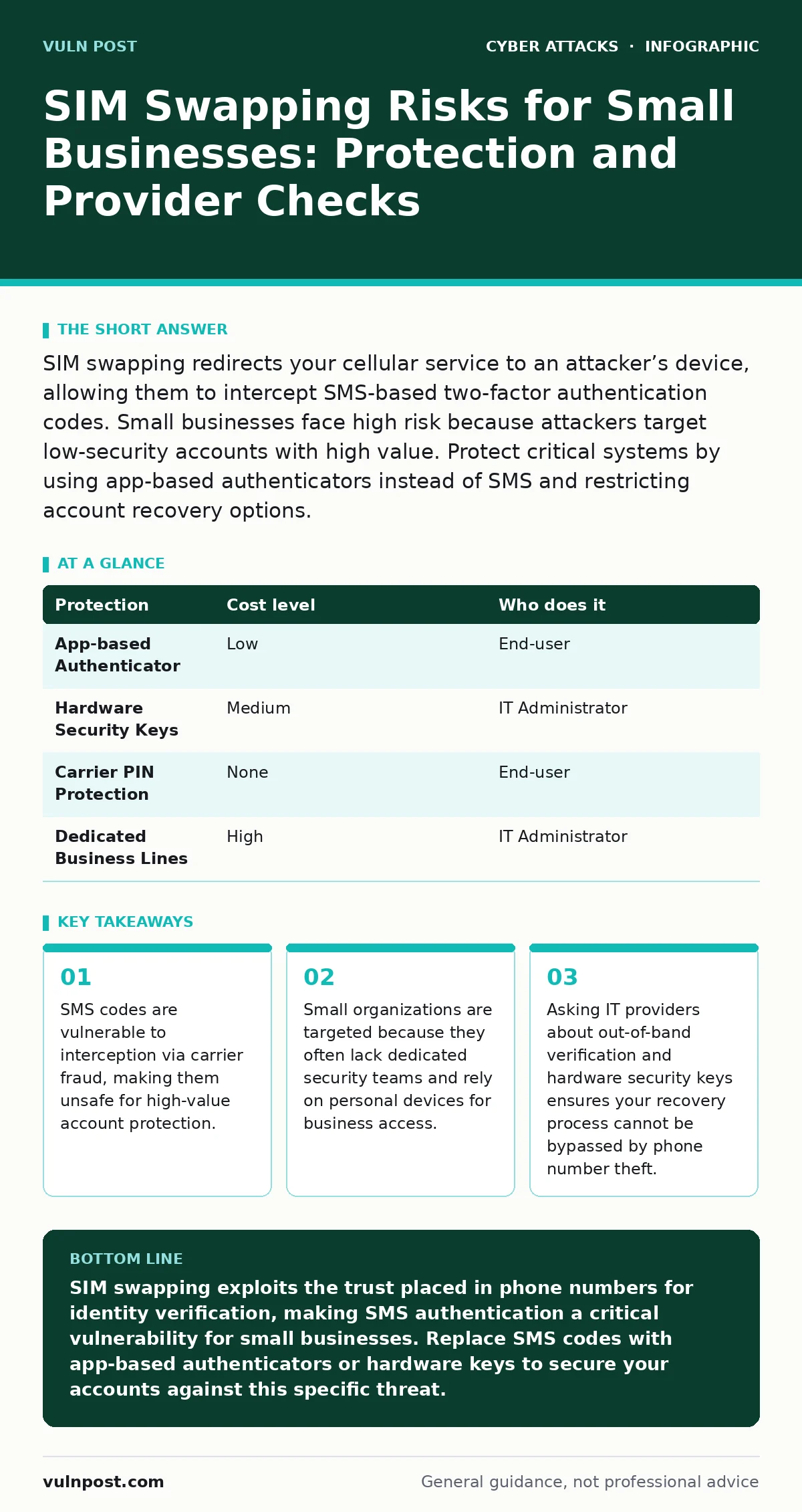
SIM swapping redirects your cellular service to an attacker’s device, allowing them to intercept SMS-based two-factor authentication codes. Small businesses face high risk because attackers target low-security accounts with high value. Protect critical systems by using app-based authenticators instead of SMS and restricting account recovery options.
The Mechanics of SIM Hijacking
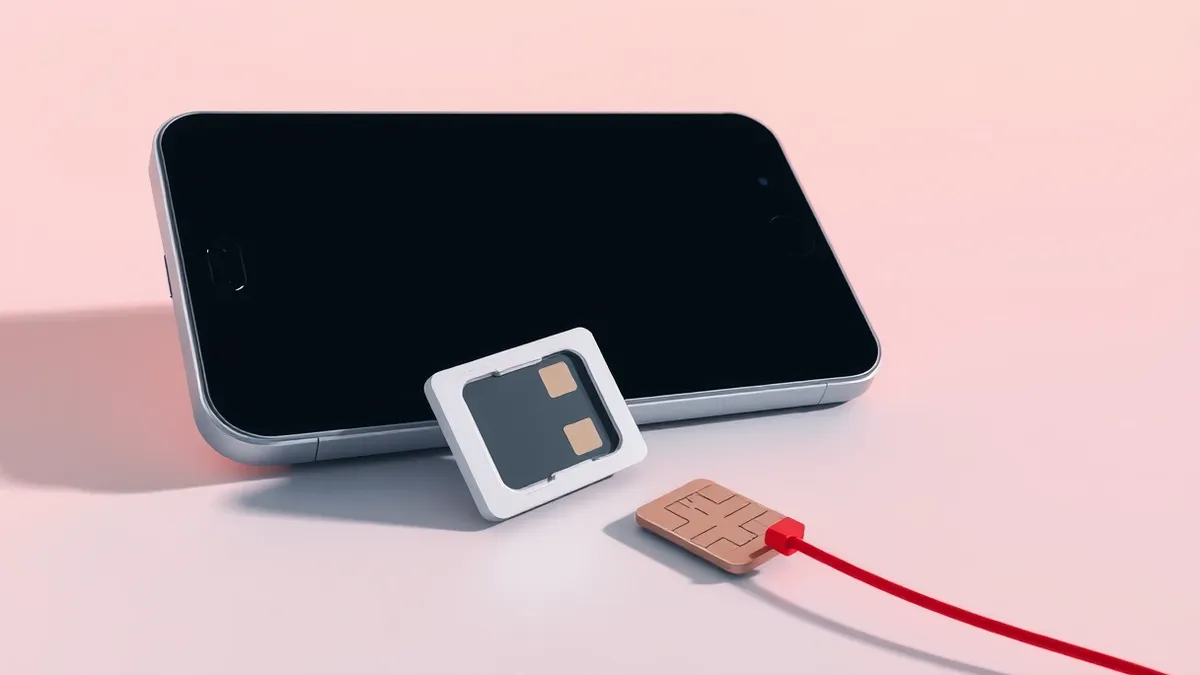
SIM swapping, also known as SIM jacking, is a social engineering attack against telecommunications providers rather than a technical exploit of your devices. The attacker gathers personal information about the target, often from social media or data breaches, to impersonate them when calling customer support. They request a port or transfer of the phone number to a new SIM card that they control.
When the carrier processes this request, your original SIM card stops working. You lose service, but the attacker’s device begins receiving your calls and text messages. This includes every one-time password sent via SMS for banking, email, or administrative portals. The attack succeeds because the security model assumes that possession of the phone number equals identity verification.
This method bypasses traditional firewalls and endpoint protection entirely. It targets the human layer and the third-party relationship between you and your mobile carrier. Understanding this mechanism reveals why standard antivirus software offers no defense against SIM swapping. The vulnerability exists in the authentication protocol, not in the operating system of your laptop or server.
Why Small Organizations Are Exposed
Small businesses often appear to be low-hanging fruit for attackers due to perceived gaps in security hygiene. However, the exposure stems more from structural dependencies than negligence. Many small teams operate with limited IT staff, leading to the use of personal mobile devices for business communications. This blurring of lines increases the attack surface significantly.
Attackers prioritize targets where the potential gain outweighs the effort required to gather intelligence. A small business owner might have direct access to financial systems, customer databases, or vendor accounts. Unlike large enterprises with strict separation of duties, a single compromised phone number can grant an attacker administrative privileges across multiple platforms.
The human factor in security plays a central role here. Employees may unknowingly share too much personal detail online, making the impersonation step easier for the attacker. Furthermore, small organizations rarely have redundant communication channels. If the primary phone line is hijacked, there is often no immediate secondary method to verify identity, leaving the organization paralyzed during the incident.
The False Security of SMS Authentication
Many organizations implement SMS-based two-factor authentication believing it provides robust security. This creates a dangerous illusion of safety. SMS messages travel over the signaling network of the cellular provider, which lacks the encryption standards of modern data transmission. They are readable by anyone who can intercept the signal or compromise the carrier’s internal systems.
Using SMS for authentication introduces a dependency on a third party you do not control. You cannot audit the security practices of your mobile carrier. You cannot enforce multi-factor authentication on the carrier’s customer support agents. This external dependency creates a weak link in your security chain that attackers actively probe.
The trade-off is convenience versus security. SMS codes are easy to enter on any device, which encourages adoption. However, this ease of use comes at the cost of verifiable identity. When an attacker controls the phone number, they control the second factor. Your authentication system then validates the attacker’s request as legitimate, granting them full access.
| Protection | Cost level | Who does it |
|---|---|---|
| App-based Authenticator | Low | End-user |
| Hardware Security Keys | Medium | IT Administrator |
| Carrier PIN Protection | None | End-user |
| Dedicated Business Lines | High | IT Administrator |
Low-Cost Protections for Critical Accounts
The most effective defense against SIM swapping is to remove the phone number from the authentication equation entirely. You can achieve this by using an authenticator app that generates time-based one-time passwords locally on your device. These codes are generated offline and never transmitted over the cellular network. Even if an attacker hijacks your SIM, they cannot access the codes stored on your physical device.
Another layer of protection involves setting a strong, unique PIN with your mobile carrier. This PIN is required before any changes can be made to your account, including SIM transfers. While this does not prevent the attack entirely, it adds a barrier that can deter opportunistic attackers or buy you time to detect the service loss. Choose a PIN that is not derived from your date of birth or other easily guessable information.
For the highest security, implement hardware security keys for administrative and financial accounts. These physical devices use public key cryptography to verify identity. They are immune to phishing and SIM swapping because the private key never leaves the device. An attacker cannot replicate the physical presence required to approve a login request. This shifts the security model from something you know to something you have.
What to Ask Your IT Provider
If you outsource your technical operations, your IT provider must understand the risks associated with identity management. You need to verify that their setup procedures do not create single points of failure. Ask specific questions about how they handle account recovery and authentication methods for your organization.
- Does the provider enforce app-based or hardware-based multi-factor authentication for all administrative access, explicitly avoiding SMS?
- How are account recovery options configured? Are there trusted devices or backup codes that do not rely on phone number verification?
- What is the procedure for verifying identity if an employee reports a lost or hijacked phone number?
- Does the provider monitor for unusual login patterns or geographic anomalies that might indicate a compromised account?
These questions ensure that your provider is not just installing software but designing a security architecture that accounts for identity theft. They reveal whether the provider understands that the phone number is a volatile asset. A competent provider will have written procedures for de-authorizing a compromised phone number and re-establishing access through secure channels.
Managing the Incident Response
When a SIM swap occurs, speed is critical. The first sign is usually a sudden loss of cellular service. If you notice this, immediately contact your carrier using a different phone or by visiting a store in person. Request that the number be ported back to your original SIM or suspended entirely.
Simultaneously, you must secure your digital accounts. Since you cannot receive SMS codes, you must use alternative verification methods. This is why having pre-configured backup codes or hardware keys is vital. Log into critical accounts from a secure network and change passwords. Enable alerts for any new login attempts or password changes.
This scenario highlights the importance of email authentication protocols. If attackers gain access to your email via SMS bypass, they can reset passwords for other services. Ensuring your email domain has proper SPF, DKIM, and DMARC records prevents attackers from sending impersonation emails that could further compromise your team.
Reducing the Blast Radius
No security measure is perfect. You must assume that an attacker might eventually compromise an identity. The goal is to limit the damage they can cause. This concept is known as reducing the blast radius. You achieve this by separating privileges and ensuring that no single account has unrestricted access to all systems.
Use role-based access control to ensure that employees only have access to the data they need to perform their jobs. A marketing employee should not have administrative rights to the financial database. If their account is compromised via SIM swapping, the attacker’s access is limited to marketing tools.
Regularly review access logs and permissions. Remove access for employees who have left the organization or changed roles. This hygiene ensures that compromised credentials do not provide lingering access to sensitive areas. It also simplifies the investigation process if an incident occurs.
The Role of External Threats
SIM swapping is often part of a broader attack campaign. Attackers may combine it with brand impersonation to trick your employees into revealing more information. They might send emails appearing to come from your CEO, asking for urgent financial transfers or sensitive data.
Understanding API abuse is also relevant. Many modern applications rely on APIs for authentication. If an attacker gains access to your account via SIM swapping, they may use API keys stored in your session to access data programmatically. This can lead to large-scale data exfiltration that is difficult to detect.
Your cyber incident response team should have a plan that includes identity compromise. This plan should outline steps for notifying stakeholders, preserving evidence, and restoring access. Regular drills ensure that your team can react quickly and effectively when the unexpected happens.
Key takeaways
- SMS codes are vulnerable to interception via carrier fraud, making them unsafe for high-value account protection.
- Small organizations are targeted because they often lack dedicated security teams and rely on personal devices for business access.
- Asking IT providers about out-of-band verification and hardware security keys ensures your recovery process cannot be bypassed by phone number theft.
SIM swapping exploits the trust placed in phone numbers for identity verification, making SMS authentication a critical vulnerability for small businesses. Replace SMS codes with app-based authenticators or hardware keys to secure your accounts against this specific threat.
Frequently asked questions
Can I use my phone number for anything if I am worried about SIM swapping?
You can use your phone number for receiving calls and texts for communication, but you should never use it for receiving security codes or two-factor authentication tokens.
Is two-factor authentication still useful if SMS is unsafe?
Yes, two-factor authentication remains highly effective when using secure
How this guide was produced: written by the Vuln Post editorial team with AI assistance, checked against the public references listed below, and reviewed when the facts change. See our editorial policy or report an error.