
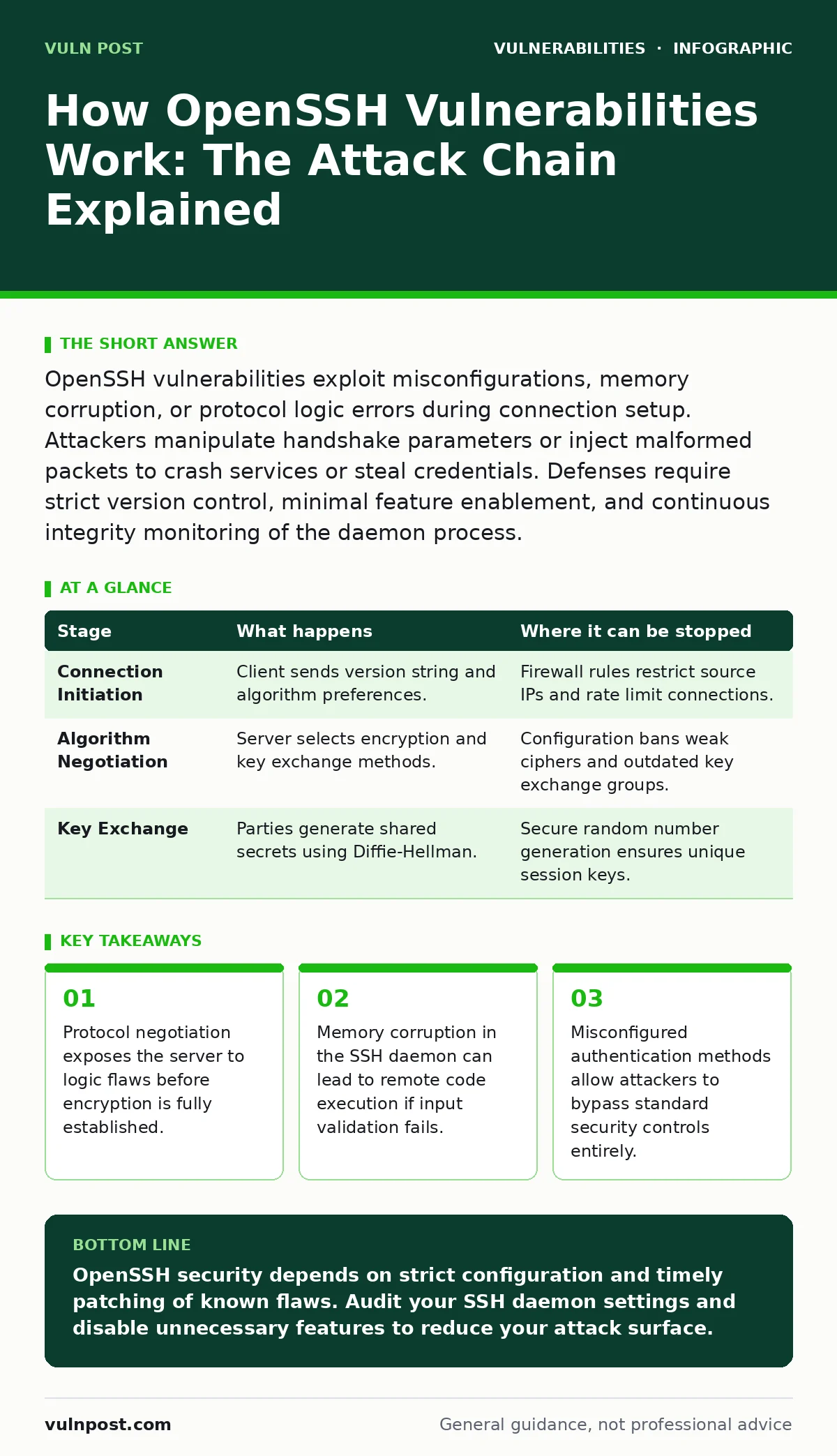
OpenSSH vulnerabilities exploit misconfigurations, memory corruption, or protocol logic errors during connection setup. Attackers manipulate handshake parameters or inject malformed packets to crash services or steal credentials. Defenses require strict version control, minimal feature enablement, and continuous integrity monitoring of the daemon process.
The Handshake Negotiation Phase
The connection begins when a client initiates contact with the SSH daemon. Both sides exchange version strings and propose supported algorithms for encryption, hashing, and key exchange. This phase is unencrypted and visible to network observers. Attackers target this stage to identify the specific software version running on the server.
Version fingerprinting reveals known weaknesses associated with that build. The daemon selects the strongest mutually supported algorithm. If the configuration allows legacy or weak ciphers, the attacker forces the use of a vulnerable algorithm. This downgrades the security posture of the entire session. The selection logic must be strictly controlled to prevent algorithm downgrade attacks.
Key Exchange and Authentication Setup
Once algorithms are agreed upon, the parties perform a Diffie-Hellman key exchange to generate shared secret keys. This process ensures that subsequent communication is encrypted. The server then authenticates the client using public keys, passwords, or certificates. Vulnerabilities here often stem from how the daemon handles authentication data.
Suppose a flaw exists in the parsing of public key data. An attacker can send a specially crafted key packet that causes a buffer overflow. This overwrites memory adjacent to the authentication buffer. The attacker gains control over the instruction pointer. This allows execution of arbitrary code with the privileges of the SSH service. Proper input validation prevents this memory corruption.
Stage 1: Network Layer Inspection
| Stage | What happens | Where it can be stopped |
|---|---|---|
| Connection Initiation | Client sends version string and algorithm preferences. | Firewall rules restrict source IPs and rate limit connections. |
| Algorithm Negotiation | Server selects encryption and key exchange methods. | Configuration bans weak ciphers and outdated key exchange groups. |
| Key Exchange | Parties generate shared secrets using Diffie-Hellman. | Secure random number generation ensures unique session keys. |
Session Establishment and Channel Creation
After successful authentication, the SSH connection establishes channels for data transfer. These channels can carry shell sessions, port forwarding rules, or file transfers. The daemon sets up internal structures to manage these concurrent streams. Flaws in channel management can lead to resource exhaustion. An attacker opens multiple channels rapidly to consume server memory.
This denial-of-service attack impacts other legitimate users. The daemon must enforce limits on the number of concurrent channels per user. It must also validate the parameters for each channel request. Failure to validate channel types can allow unauthorized access to system resources. The separation between different session types must be strict.
Command Execution and Privilege Separation
The core function of SSH is often remote command execution. The daemon spawns a shell process for the authenticated user. Modern implementations use privilege separation to limit the impact of bugs. The main daemon runs with high privileges to listen for connections. A child process handles the actual session with lower privileges.
If a vulnerability exists in the session handling code, the attacker is confined to the low-privilege sandbox. However, flaws in the privilege separation mechanism itself can bridge this gap. An attacker exploits a race condition or memory error to escape the sandbox. This grants access to the full system. Ensuring the boundary between privileged and unprivileged code is unbreakable is critical.
Stage 2: Session and Execution Handling
| Stage | What happens | Where it can be stopped |
|---|---|---|
| Channel Setup | Server creates channels for shell or file transfer. | Limits on concurrent channels prevent resource exhaustion. |
| Privilege Drop | Daemon drops root privileges for user session. | Strict privilege separation prevents sandbox escape. |
| Command Execution | Shell process runs user commands. | Input sanitization prevents command injection attacks. |
Data Transfer and Integrity Verification
During the session, data moves between client and server. The SSH protocol uses message authentication codes to ensure data integrity. Each packet is tagged with a MAC derived from the session keys. The receiver verifies this tag before processing the data. If the tag fails, the packet is discarded. Vulnerabilities can arise in the implementation of these checks.
Suppose the code incorrectly handles MAC validation errors. An attacker might inject malicious data that bypasses the check. This leads to data corruption or command injection. The integrity check must be performed before any data processing occurs. Time-of-check to time-of-use races can undermine this protection. Atomic verification steps prevent such bypasses.
Session Termination and Cleanup
When the session ends, the daemon cleans up resources. It closes file descriptors, frees memory, and destroys cryptographic keys. Improper cleanup can leave residual data in memory. An attacker with local access might read this memory to recover session keys. This allows decryption of recorded traffic. The daemon must securely zero out sensitive memory before freeing it. It must also close all open file handles to prevent resource leaks. Failure to clean up properly can lead to information disclosure. It can also cause the daemon to crash under load. Robust cleanup routines ensure that no traces of the session remain. This limits the attack surface for post-exploitation activities.
Stage 3: Post-Session Integrity
| Stage | What happens | Where it can be stopped |
|---|---|---|
| Resource Release | Memory and file handles are freed. | Secure memory wiping prevents key recovery. |
| Key Destruction | Session keys are erased from memory. | Cryptographic erasure ensures keys are unrecoverable. |
| Log Generation | Access records are written to disk. | Centralized logging detects abnormal termination patterns. |
Configuration and Patch Management
The most effective defense against OpenSSH vulnerabilities is proper configuration. Disable unused features such as X11 forwarding or TCP forwarding. Restrict authentication methods to public keys where possible. Regularly update the SSH software to the latest stable version. Patches fix known memory corruption and logic flaws. Monitor for new vulnerabilities in the cryptographic libraries used by SSH. Apply updates promptly to close security gaps. Audit the configuration file for deviations from security baselines. Use automated tools to check for misconfigurations. This proactive approach reduces the likelihood of exploitation. It also minimizes the impact of any undiscovered flaws.
Key takeaways
- Protocol negotiation exposes the server to logic flaws before encryption is fully established.
- Memory corruption in the SSH daemon can lead to remote code execution if input validation fails.
- Misconfigured authentication methods allow attackers to bypass standard security controls entirely.
OpenSSH security depends on strict configuration and timely patching of known flaws. Audit your SSH daemon settings and disable unnecessary features to reduce your attack surface.
Frequently asked questions
How do attackers find vulnerable OpenSSH versions?
Attackers scan networks for version strings in the initial handshake. They cross-reference these versions with known vulnerability databases to identify exploitable targets.
Can privilege separation prevent all remote code execution?
No, privilege separation limits the impact of bugs in the session handler. Flaws in the separation mechanism itself or in the privileged part of the daemon can still allow full compromise.
What is the risk of using weak ciphers in OpenSSH?
Weak ciphers make it easier for attackers to decrypt session traffic. They may also be vulnerable to mathematical attacks that recover the session key, exposing all transmitted data.
How does input validation prevent SSH exploits?
Input validation ensures that the daemon only processes well-formed data. It prevents malformed packets from causing buffer overflows or logic errors that could lead to code execution.
How this guide was produced: written by the Vuln Post editorial team with AI assistance, checked against the public references listed below, and reviewed when the facts change. See our editorial policy or report an error.