Key points
- The vulnerability affects Astral uv versions prior to 0.8.22.
- A CVSS score of 8.7 classifies the risk as high severity.
- Malicious source distributions can redirect file writes to arbitrary locations.
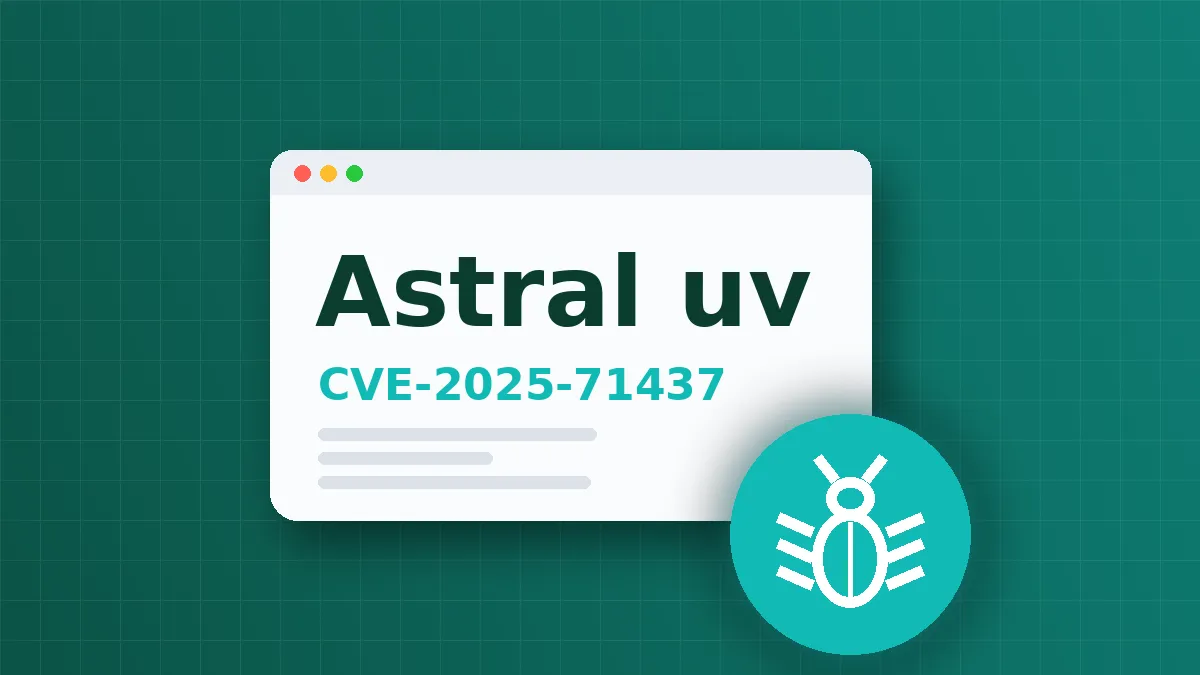
Astral uv versions before 0.8.22 contain a path traversal vulnerability that allows arbitrary file writes. The flaw exists in how the tool extracts source distribution tar files. Attackers can exploit this by publishing a malicious package. When a victim installs this package, the tool writes files outside the designated installation prefix. This behavior bypasses standard containment measures for package installations. Users must upgrade to version 0.8.22 to resolve the issue.
In plain English
The bug involves how the software handles symbolic links during extraction. A specially crafted sequence of symlinks can trick the extractor. It redirects file writes to locations outside the intended folder. This means an attacker can place files anywhere on the filesystem. The vulnerability is triggered during the installation of a malicious source distribution. It does not require remote execution on the server itself. The risk comes from trusting the integrity of downloaded packages.
The background
The National Vulnerability Database lists this issue as CVE-2025-71437. It carries a CVSS score of 8.7, which is rated as high. The weakness is categorized under CWE-22, which covers path traversal errors. This incident follows similar issues in other tools. As Vuln Post reported on 2026-10-13, Wazuh had a similar flaw. That bug allowed cluster workers to write arbitrary files. Another case involved Advantech ADAM-3600, fixed in October 2026.
What changes now
Users must update their Astral uv installations immediately. The vendor has released version 0.8.22 to address the vulnerability. This update fixes the logic that handles symlink sequences. Organizations should verify their current version number. If they are running any version up to 0.8.21, they are affected. The fix is available for download now. Delaying the update leaves systems exposed to malicious packages.
Who needs to act first
Teams should prioritize systems that automatically install packages from public repositories. These environments face the highest exposure to malicious uploads. Update build servers and CI/CD pipelines first, as they often fetch dependencies without human review. Test the new version in a staging environment before deploying to production. Ensure backup procedures are current before applying the update. Monitor logs for any unusual file creation events during the transition.
What to do and how to stay safe: Astral uv
- Verify the installed version of Astral uv on all servers and workstations.
- Upgrade to version 0.8.22 as soon as possible to apply the fix.
- Review recently installed packages for any signs of tampering or unexpected files.
- Monitor file system integrity for writes outside the expected installation directories.
Step-by-step guide: 7 Configuration Errors That Expose Systems to Zero-Day Exploits
General security guidance from the Vuln Post newsroom. It is not confirmed advice from the organisations named in this story.
Frequently asked questions
Which versions of Astral uv are affected by this vulnerability?
All versions before 0.8.22 are affected, including version 0.8.21.
Is there a fix available for this path traversal bug?
Yes, version 0.8.22 resolves the issue for affected users.
What is the severity rating of CVE-2025-71437?
The vulnerability has a CVSS score of 8.7, which is classified as high.